Lo-Fi & Character Microphones for Vintage Samples: From Italian Parlor Guitars to Tape Grit
A masterclass in character recording for sample makers: how dark ribbon mics, bandpass resonators, harmonica dynamics, piezos, and cassette tape mics transform acoustic instruments into vintage gold.
By GETLOOPS Editorial
7 min read
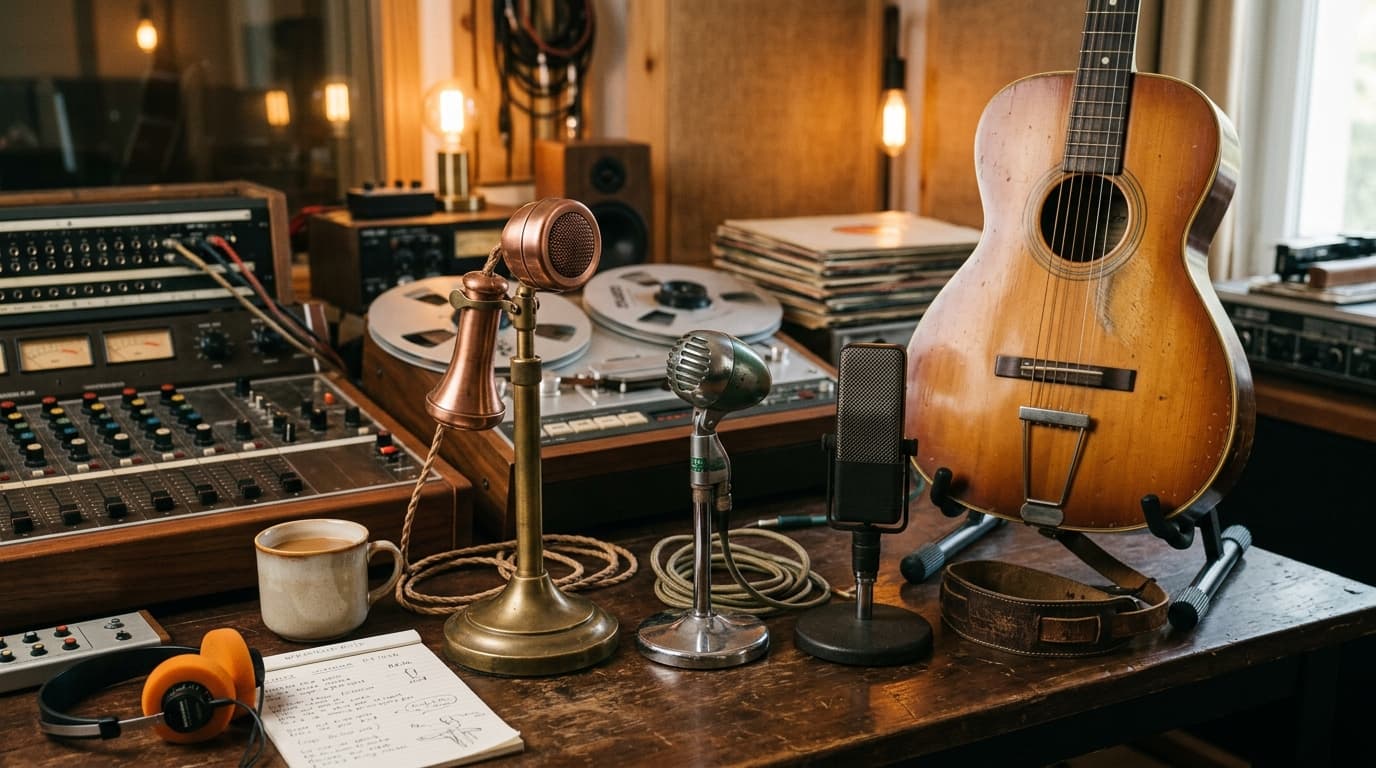
Modern music production often suffers from too much fidelity. You plug a pristine $1,000 condenser into an ultra-linear audio interface, record an acoustic instrument, and wonder why the result sounds clinical, sterile, and disconnected from the timeless records that inspire you.
When producing vintage-tinted sample packs — especially those channeling 1960s and 70s Italian library music (Piero Umiliani, Ennio Morricone, Alessandro Alessandroni) or nostalgic bedroom lo-fi — character should happen at the acoustic-to-electrical transducer stage, not just on your plugin chain.
Slapping an RC-20 or vinyl flutter plugin on a razor-sharp modern recording can help, but it never feels the same as capturing unique physical air movement, harmonic coloration, and mechanical frequency limitations right at the source.
Here is an exploration of creative, lo-fi, and vintage character microphones, and how to use them on eccentric acoustic instruments like 1960s Italian parlor guitars, mandolins, and acoustic oddities.
The 5 Character Transducer Archetypes
To capture distinct vintage flavors, you need tools with intentional acoustic quirks rather than clinical flat-response curves.
- Models: Golden Age Project R1 MK2, MXL R144, vintage Oktava ML-52.
- Acoustic profile: Natural high-frequency roll-off starting around 8–10 kHz; fast aluminum ribbon transient response.
- Best for: Nylon strings, mandolins, Italian parlor acoustics, and gut strings.
- Models: Placid Audio Copperphone, Placid Audio Resonator, DIY carbon mics.
- Acoustic profile: Bandpass curve (200 Hz – 3 kHz) with mechanical resonant hollows and rolled-off extremes.
- Best for: Secondary character mics, arpeggiated riffs, and distant room textures.
- Models: Shure 520DX 'Green Bullet', vintage Astatic JT30, Turner dispatch mics.
- Acoustic profile: High-impedance output, aggressive 2–4 kHz midrange push, natural compression when hit hard.
- Best for: Fast percussive fingerpicking, slide guitars, and vintage wooden percussion.
- Models: Korg CM-300 contact mic, Schatten transducers, cheap stick-on piezo discs.
- Acoustic profile: Extreme transient speed, zero room noise, crisp hyper-focused tactile attack.
- Best for: Layering under air mics for physical wood knock, string scrapes, and rhythmic percussive texture.
Why Italian & European Vintage Guitars Sound Unique
If you've ever played an authentic 1960s Italian guitar — such as an Eko Ranger, Crucianelli, Wandre, or Carmelo Catania parlor — you know they do not sound like a modern Martin or Taylor dreadnought.
These instruments were constructed with unique regional characteristics:
- Ladder Bracing: Unlike modern X-bracing that produces balanced, resonant bass and sustain, vintage European ladder bracing yields a quick, dry, boxy punch with immediate decay.
- Trapeze Tailpieces & Floating Bridges: Common on Sicilian and central Italian guitars, these produce higher string tension behind the bridge and a distinct metallic plink reminiscent of gypsy jazz and Mediterranean folk records.
- Compact Parlor Bodies: Emphasize the 400 Hz – 2 kHz vocal midrange, sitting effortlessly inside a hip-hop beat or cinematic sample without muddying the low end.
When you point a clinical condenser mic at these instruments, the results can be unforgivingly thin or metallic. But when paired with a ribbon or character dynamic, the boxy midrange turns into pure warm nostalgia.
Transducer Comparison: Tonal Characteristics
| Microphone Type | Core Frequency Window | Harmonic Texture | Noise Floor | Best Vintage Instrument Pairing |
|---|---|---|---|---|
| Passive Ribbon (e.g. R1 MK2) | 30 Hz – 12 kHz (smooth roll-off) | Silky, analog, tape-like warmth | Low (requires clean preamp gain) | Nylon guitar, Sicilian mandolin, bowed strings |
| Resonator Mic (e.g. Copperphone) | 200 Hz – 3.2 kHz (tight bandpass) | Metallic hollow resonance, AM radio | Moderate (capsule character) | Arpeggiated parlor lines, distant ambient fills |
| Harmonica / Bullet (e.g. Shure 520DX) | 100 Hz – 5 kHz (peaked midrange) | Gritty, slightly saturated compression | Low to moderate | Blues slide, picked acoustic bass, small drums |
| Contact Piezo (e.g. Clip-on disc) | 80 Hz – 8 kHz (spiky upper mids) | Direct, mechanical, hyper-tactile | Very low (immune to acoustic room bleed) | Taped behind acoustic bridge, wooden percussion |
| Dictaphone Cassette Mic | 150 Hz – 7 kHz (unpredictable) | Lo-fi flutter, tape saturation, hiss | High (inherent analog tape floor) | Full room capture, rhythmic background loops |
The "Dual-Transducer Blend" Technique
The secret behind world-class vintage sample packs is almost never using a character microphone in total isolation. If your entire signal is routed through a bandpass telephone mic, your sample can quickly sound hollow and fatigue the listener's ears.
Instead, sample makers utilize the Dual-Transducer Blend:
- 1Set Up Your Body Anchor (Transducer 1)Position a ribbon mic (or neutral dynamic) 10 to 14 inches from the 12th fret of the guitar. Angle it 45 degrees towards the soundboard. This track captures the fundamental warmth, woody lows, and smooth string decay.
- 2Introduce the Character Element (Transducer 2)Set up your lo-fi mic. Place a Copperphone 18 inches away aimed at the upper bout, or stick a piezo contact pickup directly to the soundboard behind the bridge.
- 3Phase-Align the Two SignalsZoom into your DAW waveform. Because Transducer 1 travels through air and Transducer 2 may be a contact mic or different distance, nudge the waveforms so the initial pick transient peaks align simultaneously.
- 4Balance & Tone-ShapeLeave Transducer 1 front and center at 0 dB. Blend Transducer 2 underneath at -8 dB to -12 dB. Drive Transducer 2 into subtle preamp or tape saturation. Pan them slightly apart (e.g., Center and 15% Left) for a wide, tactile vintage stereo field.
Mic Placement Tips for Quirky Vintage Acoustics
- Beware the Trapeze Zing: If your Italian guitar has a trapeze tailpiece, the string length between bridge and tailpiece rings out sympathetically. If it's too harsh, weave a strip of felt or masking tape through the strings behind the bridge. If you want spaghetti-western drama, point your contact mic directly at that tailpiece area.
- Angle Over Distance for Ribbons: Ribbon mics have a pronounced figure-8 pickup pattern with deep side nulls. You can position the rear lobe away from reflective computer monitors or noisy street windows to isolate the instrument naturally.
- Use the Proximity Effect to Fatten Small Bodies: Parlor guitars naturally lack sub-200 Hz energy. Moving a ribbon mic 3 to 4 inches closer to the body dramatically blooms the low-mid resonance, giving an antique small-body guitar the perceived mass of an auditorium acoustic.
Final Thoughts
The goal of creating vintage samples is not to fake history with heavy-handed digital plugins. It's to embrace acoustic imperfection at the moment the string vibrates the air.
Whether it's an affordable figure-8 ribbon mic soaking up nylon warmth, a green bullet mic biting into a picked melody, or a piezo contact pickup capturing the creak of aged Italian spruce, real transducers bring a tactile, human depth to your sound that listeners feel immediately.