The Best Microphones to Record Instruments Under $200 (Plus a Secret Weapon)
A practical guide to recording acoustic guitars, percussion, and textures on a budget: four versatile sub-$200 workhorse mics plus a vintage harmonica mic for instant lo-fi warmth.
By GETLOOPS Editorial
6 min read
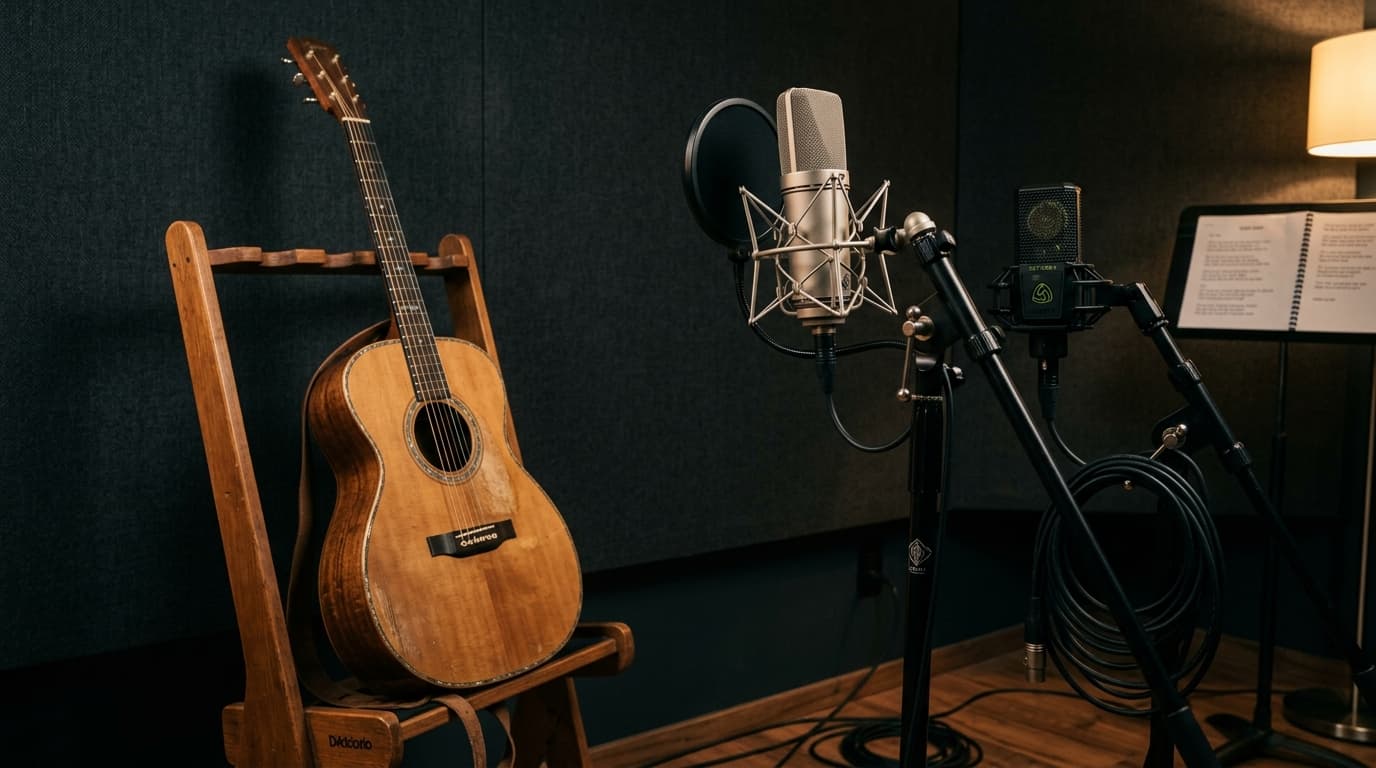
One of the biggest misconceptions in modern sample making is that you need a $1,500 Neumann or a boutique tube pre-amp before your recorded acoustic instruments can sound professional.
They don't. In fact, if you're tracking in an untreated bedroom or home studio, an ultra-sensitive high-end condenser will often make your samples sound worse by capturing computer fan noise, traffic rumble, and flutter echoes off your drywall with clinical precision.
Under $200, modern microphone manufacturing has gotten remarkably good. You don't need an entire mic locker to create high-tier loop packs. You just need to understand the acoustic job each microphone was built to do.
Here is an honest breakdown of the four best sub-$200 microphones for tracking acoustic guitars, percussion, and real-world textures, plus a bonus creative secret weapon that delivers instant vintage character right at the capsule.
Dynamic vs. Condenser: The Core Decision
Before picking a microphone, you need to match its physical transducer type to your room and your instrument:
Heavier diaphragms that require high acoustic pressure to move. They naturally reject background room noise and handle extreme volume without distortion. Perfect for untreated bedrooms and loud, punchy instruments.
Ultra-lightweight electrically charged gold capsules that react to the subtlest acoustic vibration. They capture delicate pick attacks, room ambiance, and high-frequency sparkle. Requires +48V phantom power.
The 4 Workhorse Mics Under $200
1. Shure SM57 ($99) — The Untreated Room Hero
There is a reason the Shure SM57 has been in every commercial recording studio on earth since 1965. It is practically indestructible, costs less than a hundred dollars, and solves the single biggest problem bedroom sample makers face: boxy room acoustics.
Because the SM57 is a dynamic mic with a tight cardioid polar pattern, it ignores the reflections bouncing off your ceiling and walls. It focuses almost entirely on what is directly in front of the grille.
If you are recording acoustic guitar body percussion, snare drums, shakers, guitar amplifier cabinets, or aggressive strummed rhythm chords, the SM57 delivers a punchy, mid-forward capture that sits instantly in a mix without needing aggressive surgical EQ.
- Best for: Acoustic percussion, guitar amps, aggressive strumming, and tracking in untreated rooms.
- Limitation: Needs healthy preamp gain (50dB+) to capture quiet, delicate fingerpicking.
2. Audio-Technica AT2020 ($99) — The Balanced Budget Workhorse
If you want the open, airy top-end of a large-diaphragm condenser without spending serious money, the Audio-Technica AT2020 remains the gold standard under $100.
Unlike many cheap entry-level condenser mics that feature harsh, brittle high frequencies to fake "detail," the AT2020 has a relatively flat, controlled frequency response. Its 16mm low-mass diaphragm captures the natural wood resonance of acoustic guitars, ukulele plucks, and hand percussion with dependable accuracy.
It does require +48V phantom power from your audio interface, and it will capture more room sound than an SM57. But if you hang a heavy blanket behind you or place acoustic baffles near the mic, it punches far above its price tag.
- Best for: Strummed acoustic guitars, kalimbas, melodic top-lines, and all-around utility tracking.
- Limitation: A slightly higher self-noise floor (20 dBA) compared to higher-end studio condensers.
3. Røde NT1 Signature Edition ($159) — The Ultra-Quiet Detail Specialist
When sample makers chop, pitch down, and heavily compress acoustic audio, a hidden enemy often reveals itself: microphone hiss. When you pitch a loop down 5 semitones and slap a compressor on it, whatever noise floor your microphone captured gets boosted right into the foreground.
This is where the Røde NT1 Signature Edition becomes a superpower. With an astonishingly low self-noise figure of just 4 dBA, it is one of the quietest studio microphones in the world at any price point.
Equipped with a true 1-inch gold-sputtered large-diaphragm capsule, the NT1 captures intimate fingerstyle nylon strings, delicate music box chimes, and subtle foley textures against a dead-silent black background.
- Best for: Fingerpicked acoustic guitar, subtle acoustic textures, quiet foley, and samples intended for heavy pitch-shifting.
- Limitation: Large body size makes tight positioning around a guitar 12th fret slightly more cumbersome than a pencil mic.
4. sE Electronics sE7 ($109) — The Small-Diaphragm Transient Hunter
While large-diaphragm mics get most of the marketing attention, professional acoustic guitar recordings are frequently tracked with small-diaphragm pencil condensers like the sE Electronics sE7.
Small diaphragms have much less physical mass, which means they can react to rapid sound waves significantly faster than a big 1-inch capsule. This gives the sE7 lightning-fast transient response — the initial "click" of a guitar pick striking a string, or the crisp bead rattle of an egg shaker.
Because of its slim cylindrical shape, you can aim the capsule with pinpoint accuracy directly at the 12th fret of a guitar (where the neck meets the body) to capture balanced string sparkle without the booming low-end resonance of the soundhole.
- Best for: Pinpoint acoustic guitar tracking, shakers, tambourines, fast acoustic runs, and stereo pairs.
- Limitation: Highly sensitive to plosives and direct air blasts; always use a pop filter or foam windscreen.
Direct Spec Comparison
| Microphone | Transducer Type | Price | Self-Noise | Standout Strength for Sample Makers |
|---|---|---|---|---|
| Shure SM57 | Dynamic | $99 | None (Passive) | Rejects untreated room acoustics; handles extreme volume |
| Audio-Technica AT2020 | Condenser | $99 | 20 dBA | Dependable, flat, balanced entry-level condenser tone |
| Røde NT1 Signature | Large Condenser | $159 | 4 dBA | Dead-silent noise floor; ideal for quiet takes & pitching |
| sE Electronics sE7 | Pencil Condenser | $109 | 16 dBA | Pinpoint directional accuracy & lightning-fast transients |
| Shure 520DX Green Bullet | Controlled Magnetic | $139 | None (Passive) | Built-in 1950s radio bandwidth & analog saturation |
The Secret Weapon: Shure 520DX "Green Bullet" ($139)
If you want clean, pristine, high-fidelity acoustic reproduction, buy one of the four mics above.
But if you make lo-fi, vintage soul, hip-hop, or moody indie samples, the Shure 520DX — affectionately known as the "Green Bullet" — is one of the most inspiring creative secret weapons you can own.
Originally designed in the 1940s as a dispatch mic and later adopted by Chicago blues harmonica legends, the Green Bullet is a heavy, rounded metallic green dynamic microphone designed to be cupped in your hand, complete with a built-in volume knob on the bottom.
Its frequency response is naturally restricted to 100 Hz – 5 kHz. That means it physically chops off sub-bass rumble and hyper-digital high-end hiss right at the physical capsule, before the sound ever enters your computer.
When you record an acoustic guitar, a vocal chop, or a wooden percussion hit through the Green Bullet and drive your interface preamp slightly hot, the diaphragm saturates with genuine analog warmth and mid-range grit. It sounds like a sample lifted straight from a dusty 1958 vinyl record without a single digital plugin engaged.
Three Practical Rules Before You Buy
- 1Diagnose your room before buying a condenserIf you have bare walls and hard floors, an SM57 will sound punchier and cleaner than an untreated budget condenser.
- 2Factor in self-noise if you pitch samples downPitching loops down multiplies background mic hiss; choose a quiet mic like the NT1 if you plan to do heavy pitching.
- 3Experiment with mic placement before touching an EQMoving the capsule three inches closer or pivoting 30 degrees changes your tone more than any plugin in your DAW.
The Bottom Line
You don't need thousands of dollars in microphone hardware to release hit sample packs:
- If your room is untreated and you track loud instruments: grab the Shure SM57.
- If you want a dead-silent studio condenser for quiet fingerpicking and foley: get the Røde NT1 Signature.
- If you want precision transient capture on acoustic strings: choose the sE Electronics sE7.
- And if you want to give your loops an undeniable vintage character that sets your packs apart: plug in a Shure Green Bullet and push the preamp.