How I Make My Guitar Samples
A real-world breakdown of recording nylon-string guitar samples: gear, room sound, mic placement, melodic experiments in FL Studio, and mixing.
By
5 min read
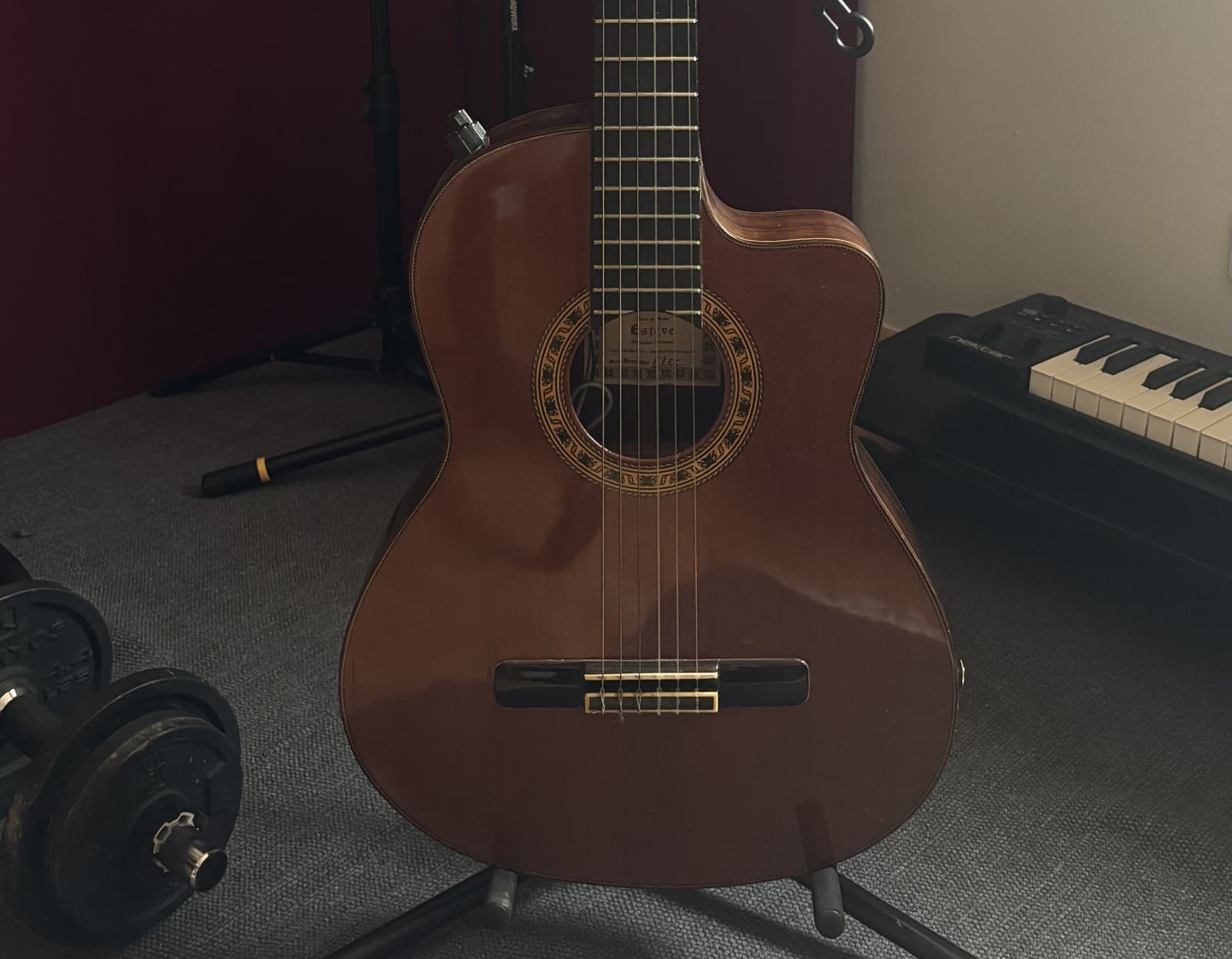
This isn't a "here's the secret formula" kind of post. It's just what I actually do, for anyone who wants to steal a piece of it.
The guitar
I play a handmade luthier guitar from Spain that used to belong to my dad. It's nylon string, and if I'm being honest, it's a bit thin sounding. I wish it had a fuller body. But the intonation on it is perfect — it stays in tune incredibly well across the whole neck, which is not something you can say about a lot of guitars, handmade or otherwise. That trade-off is one I've made peace with.
The thin body does mean I have to be careful with how I play. If you dig in with your fingers the wrong way on a guitar like this, it starts sounding nasal and thin fast. So I've had to actually pay attention to finger placement and attack in a way I probably wouldn't need to on a fuller-bodied instrument. For melodies specifically, I almost always reach for a pick instead of playing fingerstyle. A pick gives the note more body and helps mask the thinness that's just baked into this guitar's character.
Worth mentioning too, I actually started out making guitars entirely on VSTs. I never took real guitar lessons, so my playing ability is honestly lackluster compared to a lot of guys who've been playing since they were kids. What I try to do instead is make up for it with interesting melody ideas. I'd rather write something a little unexpected with imperfect technique than play something technically clean and forgettable.
What I record with
Right now my chain is a Rode NT1A into a Focusrite Scarlett 2i2 3rd gen. Nothing fancy. I'm actually looking to upgrade to a pencil condenser at some point, mostly for the tighter pickup pattern.
Here's something I've noticed though — the interface itself doesn't move the needle much when you're recording nylon string. Where an interface actually matters is if you're plugging in an electric guitar directly, or if you're running a dynamic mic, which needs more clean gain to sound right. For a condenser mic on an acoustic nylon guitar, the difference between interfaces is a lot smaller than people think.
Recording process
Mic placement is the part everyone wants a rule for, and I don't think there is one. People love saying "point it at the 12th fret" like it's gospel, but I disagree. It really depends on the room you're in. My room has its own sound, reflections, whatever character it has, and that changes what placement actually sounds good. You have to just move the mic around and listen, not follow a diagram.
Once I've got a placement I like, I start by recording a chord progression. While I'm playing it, I'm thinking specifically about how the bass notes move underneath the chords, because that movement is usually what makes a progression interesting instead of just correct. If you want to go a step further, record the same progression twice and pan the two takes to opposite sides in the mix. It widens things out in a way a single take never will.
Once I'm happy with 4 or 8 bars of chords, I copy and paste that loop for ages in FL Studio, so it just plays on repeat while I experiment with melody ideas on top. I'm not trying to nail a melody in one pass. I'm giving myself a long runway to try things.
One of my favorite tricks, and honestly where some of my best samples have come from, is recording a melody and then nudging it to a different spot in the progression using FL Studio's cut and move tools. The melody ends up landing somewhere it was never actually played, and sometimes that accident works way better than what I originally intended. I'd never have found it by playing alone.
The other trick, which is probably more well known but still worth saying, is thinking in call and response. Play a short phrase that feels unfinished, like it's asking a question, and then write a second phrase that answers it. That back-and-forth is what makes a lot of melodies feel like they're actually going somewhere instead of just repeating.
Mixing
Honestly, forget most of what you've read about mixing guitar. The only thing that actually matters is understanding the room you recorded in.
I record in my bedroom, which is untreated. Because of that, I know if I throw reverb on the recording, it's going to sound a bit off, since I'd be stacking reverb on top of the room's natural reflections. If your room is untreated too, I'd genuinely consider building some acoustic panels. I have three that I used to place around the mic when recording, though these days I just leave them lying around because I've started preferring to record at my desk instead. If your room doesn't have this problem, plate reverb is one of the most beautiful things you can put on a guitar recording, so use it.
Past the reverb decision, I always cut a good amount of the low end with EQ. Nylon guitars build up a lot of low-mid mud that doesn't need to be there. For boosting, my go-to is the Waves EQP1A on melodies specifically, since it lets you boost the lower mids in a way that adds real body back into the sound, which helps counter the thinness of my guitar in the first place.
Beyond that, I lean on Fresh Air a lot, and cassette emulators are basically essential in my chain at this point — stuff like RC-20 or the Waves cassette plugins. They add just enough grit and character that a clean digital recording starts to feel warmer and more alive.
But honestly, keep your mixing simple. The recording and the actual playing matter more than anything you do after the fact. If the take isn't good, no plugin chain is going to save it.
One last thing
It's really common to hate your own stuff. I hate my stuff, pretty much all the time. So if you're going through your own recordings and feeling that way, just know it happens to literally everyone. Doesn't mean it's bad, usually it's just because you're used to your own sound.